
By Brenda Tassava Medina, CVPM, CVJ
To learn more about our Veterinary Fee Consults, visit The Nest here!
Fee schedules have a funny way of becoming invisible.
You use them every day. Your team enters charges. Clients pay invoices. Revenue comes in. And once or twice a year, someone looks at the numbers, adds a percentage, updates the PIMS, and calls the job done.
Sound familiar?
That approach is easy. It is also a terrible way to understand whether your fees are actually working for your practice.
Some prices may be right where they belong. Others may be quietly costing you thousands of dollars in lost revenue. And a few may be high enough that clients notice, compare, and make a different choice.
Your fee schedule is telling you a story.
The question is whether you’re listening.
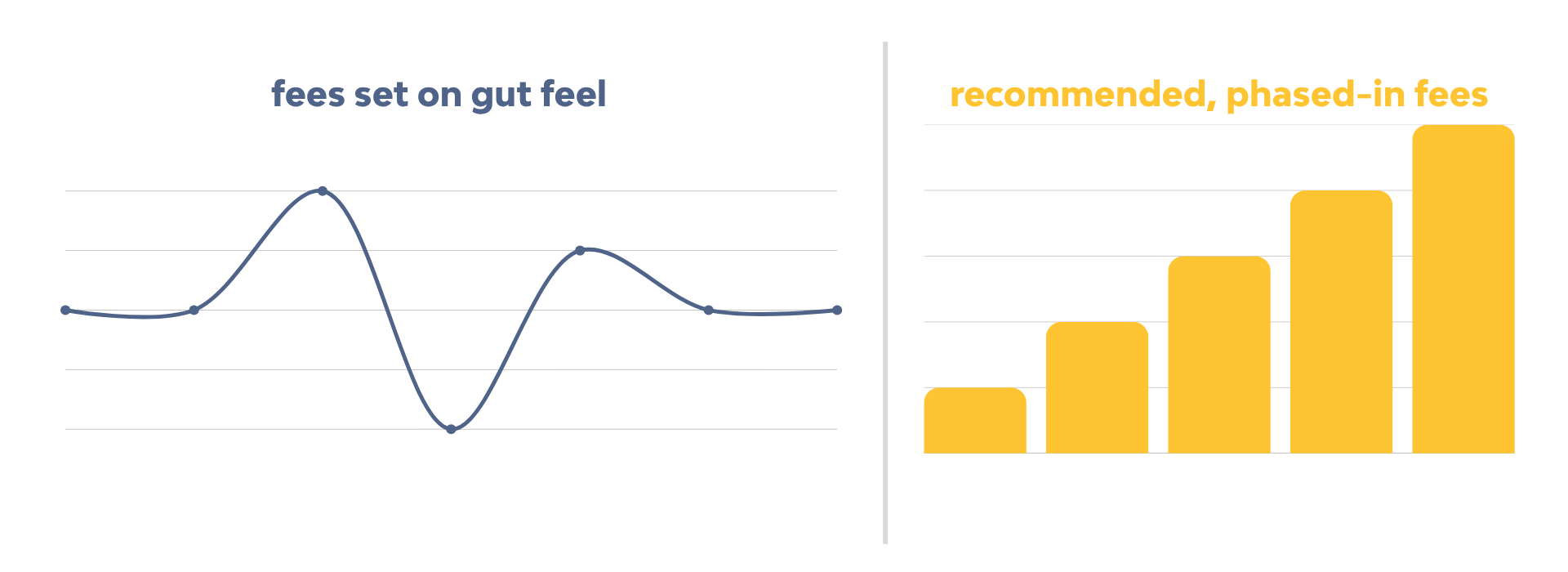
PRESENTING ISSUE = Revenue underperformance, cause unclear
SYMPTOM = gut-feel pricing, erratic and unexamined fees
TREATMENT = benchmarked, phased, evidence-based
You know something’s off. You just can’t see where.
I hear a version of this conversation all the time.
“Our expenses keep climbing.”
“Payroll is up.”
“Revenue looks okay, but our profit is shrinking.”
“We’ve raised fees, so why aren’t we seeing the results?”
The immediate reaction is usually the same: raise prices again.
But that’s where practices get into trouble, because a 5% increase applied across an entire fee schedule assumes every service behaves exactly the same way.
It doesn’t.
A routine examination is different from an abdominal ultrasound. A heartworm test is different from a dental procedure. Clients know what an exam costs. They may know what vaccines cost. They can call three hospitals in twenty minutes and compare those prices.
Try doing that with a complicated dental procedure.
Very different conversation.
And this is where fee strategy gets interesting, because the opportunity isn’t found in asking, “How much should we raise prices this year?”
The better question is, “Which fees should change, by how much, and why?”
You can’t answer that from instinct alone.
You need data.
THE TRUTH = a flat percentage increase treats a routine exam and a surgical dental the same way. They aren’t the same. One gets compared constantly. The other rarely does.
DIAGNOSIS = Root Cause: uniform pricing applies to non-uniform demand
Why “just raise your fees” is bad medicine
Every line item on your fee schedule responds differently when the price changes.
Vaccines, heartworm tests, routine fecals, wellness examinations and other familiar services are easy for clients to compare. Increase them too aggressively and people notice.
Some will ask questions.
Some will shop.
Some will leave.
Surgery, dentistry and diagnostics behave differently. Clients don’t usually call five veterinary practices asking for the price of an exploratory laparotomy before deciding where to go, and when those services are underpriced, the hospital absorbs the difference every single time the procedure is performed.
That adds up. Fast.
This is why we separate services according to price sensitivity.
Elastic
Price-shopped services
Move carefully. Know the local market. Watch client response.
Moderate
Services with some comparison shopping
These can tolerate steady corrections, but they still deserve attention.
Inelastic
Services clients rarely price-shop
This is where we often find significant underpricing.
And that’s the problem with plugging a percentage into a spreadsheet and pushing “update.”
The math is easy.
The strategy isn’t.
Your practice has its own service mix, client volume, demographics, competition and current pricing structure. All of those pieces matter, and they need to be examined together.
THE WORK-UP = Five-step demographic benchmarking
How a proper fee exam actually works
A fee analysis starts with your practice.
Not somebody else’s practice.
Yours.
The goal isn’t to copy a national benchmark or chase the hospital down the street. The goal is to understand where your fees sit, what your market can support, where your biggest opportunities are hiding, and which changes deserve your attention first.
Here’s how we approach it.
1. Pull your real numbers
We begin with the services your hospital actually performs, looking at volume and revenue. No assumptions. Your data tells us where to start.
2. Benchmark nationally
Next, we compare those services against current fee benchmarks from well-managed veterinary practices. Now we have context. A benchmark does not tell us what your fee should be, but it tells us where your current fee sits relative to the profession. That is valuable information.
3. Adjust for your market
A veterinary hospital in Manhattan operates in a different economic environment than a hospital in rural Indiana. So geography matters. We examine local income, housing values and cost of living to calculate a demographic adjustment that reflects the community your hospital actually serves. And this step changes the conversation. Instead of asking what veterinary practices charge nationally, we are asking what makes sense in your market.
4. Check the street
Clients do not compare every veterinary fee. They compare a handful. Those are the services where we want to know what nearby competitors are charging, because local price perception matters when clients can easily pick up the phone and shop.
5. Build the roadmap
Then we put everything together. You get recommendations organized by priority and confidence, with changes phased so your team is not trying to overhaul hundreds of fees at once. Clear choices. Clear reasoning. Clear next steps.
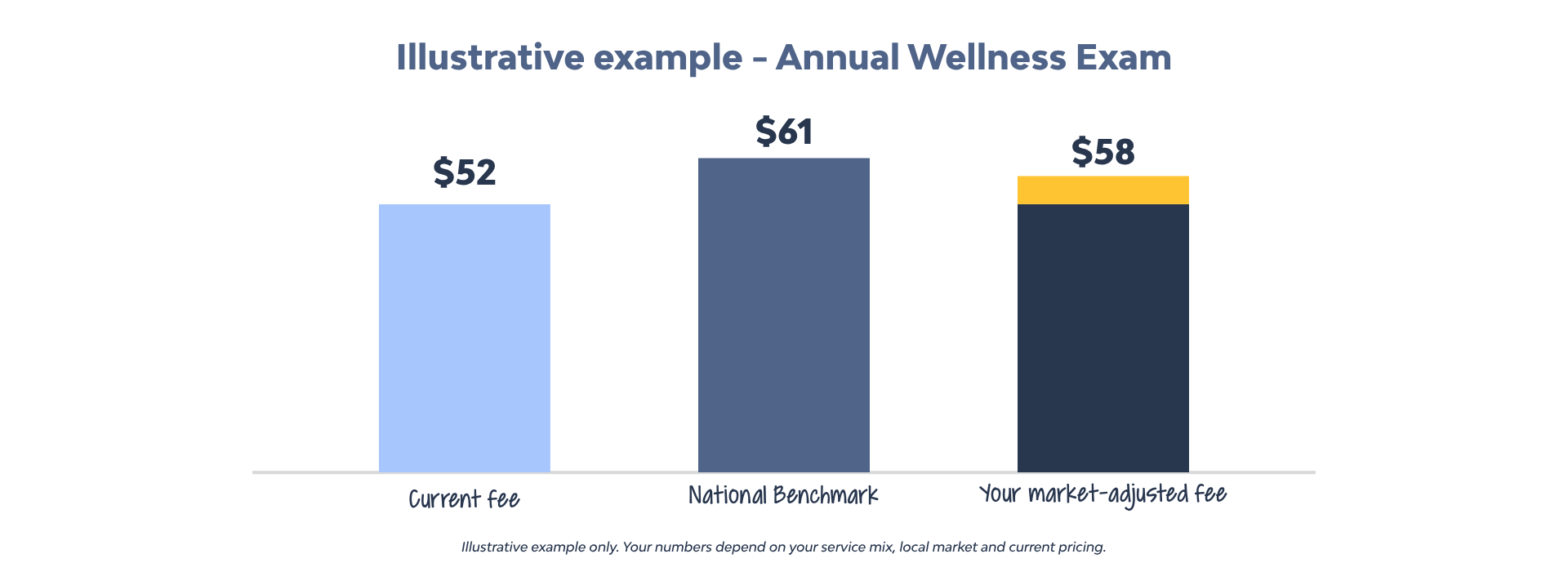
Imagine, for example, that your annual wellness exam is currently $52. The national benchmark is $61, but your local demographic analysis indicates that $58 is a better fit for your market.
The answer isn’t automatically $61 simply because that’s the benchmark.
Your answer is $58.
That’s the difference between collecting data and using it to make a decision.
LAB RESULTS = Read with caution: findings do not all carry the same certainty
We tell you what we’re sure about. And what needs a second look.
I don’t believe in handing a practice owner a giant spreadsheet filled with recommendations and pretending every number carries equal weight.
It doesn’t.
Some findings are obvious.
Fix them.
Others raise questions that need to be answered before you touch the fee.
So we separate findings into three groups.
High confidence
Act now
These are the clearest opportunities. The data supports the change, the service category supports it, and the market supports it.
Scope verification
Confirm the details first
Sometimes the fee looks wrong because we do not yet know exactly what is included in the service. Check first. Change second.
Billing audit candidates
Investigate inside your PIMS
This one can be eye-opening.
A service may show significant volume and zero revenue. Sometimes that is intentional because the charge is bundled into another service or included in a wellness plan.
But sometimes it means the service isn’t being billed.
That’s no longer a pricing issue.
It’s a revenue-capture problem.
And if your team performs the work but the charge never reaches the invoice, increasing the fee won’t fix anything.
TREATMENT PLAN = Delivery: phased over four quarters
No practice should swallow a fee overhaul in one gulp
Finding an opportunity is one thing.
Implementing it well is another.
If an analysis shows dozens, or even hundreds, of fees that deserve attention, changing all of them on Tuesday morning isn’t a strategy. It’s chaos.
Your team needs time to understand the changes. Your clients need time to absorb them. And leadership needs enough breathing room to watch what happens after each adjustment.
So the work is phased.
Q1: Undervalued, inelastic fixes
Start where the data is strongest and client price sensitivity is lowest.
Q2: PIMS billing audit fixes
Correct missing charges, inappropriate bundling and other revenue-capture problems.
Q3: Moderate-elasticity items
Address services that need adjustment but deserve a more measured approach.
Q4: Price-shopped items
Review your highest-visibility fees with fresh competitive and client-response data before making the next change.
Some practices can move faster.
Others need more time.
The sequence comes from the findings, not from a canned calendar.
PROGNOSIS = Expected outcome: clarity, confidence and a defensible number
What you walk away with
Here’s what I want practice leaders to stop saying:
“We think our fees are about right.”
Think?
That’s a lot of faith to place in something that affects nearly every dollar coming through the hospital.
You should know.
You should know where your fees sit against well-managed veterinary practices. You should know which services are sensitive to price and which are not. You should know how your local market changes the equation. You should know which fees need attention now and which can wait.
And you should be able to explain the reasoning.
That changes the conversation with your leadership team.
It changes the conversation with your accountant.
It changes the conversation when you’re planning next year’s budget or looking at declining margins and trying to understand why working harder isn’t producing better financial results.
Your final analysis gives you:
- A full comparison of your fees against national well-managed-practice standards
- Market adjustments based on the economics of your own community
- Service-by-service recommendations based on price sensitivity
- Priorities ranked by confidence
- Billing issues that deserve investigation
- A phased plan your team can actually execute
- Editable tools you can continue using as your practice changes
That isn’t another annual fee increase.
It’s a pricing strategy.
SCHEDULE YOUR EXAM
Let’s find out what your fee schedule is actually telling you.
Encore Veterinary Consulting performs this analysis for independent veterinary practices across the country, from small rural hospitals to large suburban practices.
We bring the benchmarking data, local market research and methodology.
You bring your service data.
And together, we figure out where your fee schedule is healthy, where it needs attention, and what changes make financial sense for your practice and the community you serve.
Because your fees shouldn’t come from a feeling.
They should have a reason.
Request a Fee Analysis
If we complete the analysis and there isn’t enough opportunity to justify the investment, we’ll tell you and refund 100% of your fee.